I recently finished a book called "How to Teach Your Baby To Read", by Glenn and Janet Doman. I enjoyed the first few chapters because it goes into depth on how children are actually geniuses. Buckminster Fuller stated that all children are born geniuses, but that we spend the "first six years of their lives degeniusing them."
Like the Montessori method, the authors of this book explain how children learn through all of their senses and they learn best when allowed to explore their surroundings. But we often limit their ability to explore their world by putting them in playpens, giving them plastic, non-breakable toys, and not letting them touch things. This isn't to say that we should let them break everything of course, but that we should be more aware of the child's hunger for learning and respect that desire.
The authors go into detail, explaining how ready children are at a very young age to take in more information than we can imagine, and they explain this from a psychological as well as a neurological perspective. Most of us underestimate their capabilities. They talk about the human brain and how unique it is in that "it is the only container of which it can be said that the more you put into it, the more it will hold."
The authors also address the subject of concentration. Many of us often draw conclusions about our child's lack of concentration because we see them go from one activity to the next, without spending very much time on any one thing. Too many times, children get labeled with terms like A.D.D. because of this. But the authors' view is that children are actually concentrating on EVERYTHING and that the problem lies in the fact that sometimes there just aren't enough things to hold that concentration.
This was a concern for me for a long time, because, ever since Sasha was a baby, it was extremely hard for me to find things that held her interest. Montessori has addressed this with the precise toys/activities for each stage of development. They also suggest things like having toys made out of wood, instead of plastic, because wood has different textures, weights, smells, etc. It is an enriching experience for the child because it stimulates the senses and it keeps them interested for longer periods of time.
I think that, due to her Montessori school environment, and maybe her age as well, this has been changing recently. I had a group of things at the table that she could work on, and she went through each activity, spending a good amount of time on each one.
It was so nice to see her focusing. The first few pictures are of her sweet expressions, and her little concentrated frown:
Coloring:


Tracing her name:


Cutting along the lines:

Using paperclips:


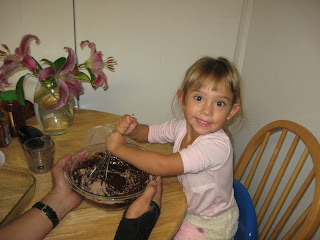
She helps Daddy cook and bake all the time. Here she is stirring a brownie mix!
She loves tracing her hand:

Baking in her "oven"


Waiting for a "wee ride" (a term used by my dad referring to a fun bump in the road)

Going for a walk:


